


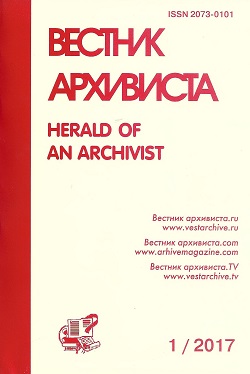







Pension provision for employees of the Ust-Sysolsky and Yarensky zemstvos of the Vologda province in the late 19th – early 20th centuries


Scientific article
DOI 10.28995/2073-0101-2026-1-45-58
For citation
Gagieva, A. K., Shestakova, A. A. (2026). Pension provision for employees of the Ust-Sysolsky and Yarensky zemstvos of the Vologda province in the late 19th – early 20th centuries, Herald of an Archivist, no. 1, pp. 45-58. DOI 10.28995/2073-0101-2026-1-45-58
Gagieva, A. K., Komi Republiсan Academy of State Service and Administration, Syktyvkar, Russia
Shestakova, A. A., Plekhanov Russian University of Economics, Moscow, Russia
Pension provision for employees of the Ust-Sysolsky and Yarensky zemstvos of the Vologda province in the late 19th – early 20th centuries
Abstract
The article based on materials from the National Archives of the Komi Republic (NAKR) examines for the first time the pension provision of zemstvo employees in one of the northern regions of the Russian Empire: the Yarensky and Ust-Sysolsky zemstvos of the Vologda Governorate in the late 19th and early 20th centuries. Drawing on a number of previously unpublished documents, the authors focus on pressing issues that have been insufficiently explored in the academic literature: the formation of zemstvo pension funds, the organization of pension and benefit payments to zemstvo officials, and cash flow management. In the late 19th and early 20th centuries the first legislative acts were adopted devoted to pension provision for zemstvo employees: teachers, doctors, junior medical personnel, and land surveyors. The inclusion of these categories among individuals with pension rights was linked, on the one hand, to the growing social significance of this new social group, and, on the other hand, to the interest of zemstvo leaders in staffing the lower echelons of zemstvo institutions. The establishment of pension funds in the region under study dates back to 1903. An analysis of documents from the National Archives of the Komi Republic reveals significant difficulties in their operation. Based on the sources the authors formulated a final conclusion regarding the reasons for the slow organization and unsatisfactory state of development of the zemstvo pension system in the region. One of the main reasons was the weak economic development of the northern region and the poverty of the population, which negatively impacted the zemstvo budget in general and the pension system in particular. The effectiveness of pension funds was low. Pension fund participants, workers in healthcare, education, and pharmaceutical institutions, could rely solely on their savings upon retirement, whereas in neighboring provinces, pension funds were supported by provincial authorities and private institutions. Low wages and difficult working conditions for zemstvo employees led to high staff turnover, which also negatively impacted the development of the pension system. The activities of pension funds in the region were limited by constant oversight by local administrations represented by city councils. Government decisions stated that zemstvo pension provision was the exclusive prerogative of the zemstvos themselves. This hindered the development of the zemstvo pension system and diminished its potential.
Keywords
Pension, zemstvo, council, cash desk, salary, fees, pension book.
Download the article: gagieva_shestakova_doi
References
Aleshin, P. N. (2021). Regional Features of the Formation of Zemstvo Bodies of Power in Post-Reform Russia, Modern Scientific Thought, no. 6, pp. 69–75.
Badanov, V. G. (2014). Olonetskoye Zemstvo, Local Self-Government Budgets, Economic History, no. 1 (24), pp. 28–44.
Vayrovskaya, S. V. (2001). Zemstvo of Komi Krai (1869–1918), Syktyvkar, Komi Scientific Center of the Ural Branch of the Russian Academy of Sciences publ., 127 p.
Veselovsky, B. B. (1911). History of the Zemstvo for Forty Years, v. 3, St. Petersburg, O. N. Popova publ., 708 p.
Golovin, K. F. (1884). Our Local Government and Local Representation, St. Petersburg, M. M. Stasyulevich publ., 165 p.
Imperially approved Regulation on the pension funds of employees in zemstvo institutions, dated June 12, 1900. (1902). Complete Collection of Laws of the Russian Empire (PSZRI), col. 3, v. XX, 1900, Section I, no. 17968–19504 and Addenda, Saint Petersburg, 1902, pp. 803–809.
Kyzyurov L. A. et al (Eds.) (2022). Minutes of the Ust-Sysolsk City Duma, 1900–1918, Collection of documents, Syktyvkar, Komi Republic publ., 646 p.
Zagryatskov, M. D. (1916). Zemstvo Service and Social Insurance (On the Issue of Zemstvo Pension Funds), Moscow, Vysshaya Shkola publ., 34 p.
History of Komi from Ancient Times to the End of the Twentieth Century. (2004). In 2 vs. v. 1. Syktyvkar: Komi Book publ., 560 p.
Karavaev, V. F. (1914). Zemstvo Estimates and Layouts. IN: Veselovsky, B. B., Frenkel, Z. G. (Eds), Jubilee Zemstvo Collection (1864–1914), Collection of Articles, St. Petersburg, O. N. Popova publ., pp. 155–179.
Kobzeva, T. A. (2015). Dynamics of Revenues and Expenditures of Zemstvos of the Middle Volga Region in the Second Half of the 19th – Early 20th Centuries, Vlast, v. 23, no. 10, pp. 193–197.
Maksimov, E. D. (1885). Zemstvo Finances, St. Petersburg. V. Demakova publ., 40 p.
Morozova, E. N. (2020). Fiscal Policy of the Saratov Zemstvo (1864–1914), Bulletin of the Saratov University, New Series, Series, History, International Relations, is. 4, pp. 542–548.
Morozova, E. N. (2021). Financial Policy of the Saratov Zemstvo: Expenditures and Budget Deficit, Bulletin of the Saratov University, New Series, Series, History, International Relations, is. 4, pp. 517–524.
Ondrikov, K. V. (2025). Expenditures of District Zemstvos of Vologda Province in 1871–1916, Bulletin of the Northern (Arctic) Federal University named after M. V. Lomonosov, Series: Humanities and Social Sciences, v. 25, no. 1, pp. 25–37.
Sivkov, K. V. (Ed.) (1955). Essays on the History of the Komi ASSR, v. 1. Syktyvkar, Komi Book publ., 352 p.
Pirumova, N. M. (1977). The Zemstvo Liberal Movement, Social Roots and Evolution to the Early 20th Century, Moscow, Nauka publ., 288 p.
Polyanina, O. A. (2014). Formation of the Russian Pension System for Municipal Employees (Based on Materials from Ufa Province), Ufa, Bashkir State University publ., 170 p.
Priklonsky, S. A. (1886). Essays on Self-Government, Zemstvo, Urban, and Rural, St. Petersburg, Obshchestvennaya Polza publ., 385 p.
Surzhikova, N. V. (Ed.) (2023). Regional Capitals of Russia – Points of Support and Growth, Proceedings of the All-Russian Conference with International Participation, Ekaterinburg – Perm, September 20–22, 2023, Alfa publ., 496 p.
Shangina, V. V. (1975). From the History of Zemstvo Institutions of the Ust-Sysolsky and Yarensky Districts. IN: Davydov, V. N. (Ed.). Questions of the History of the Komi ASSR, Transactions of the Institute of Language, Literature and History of the Komi Branch of the USSR Academy of Sciences, is. 16, Syktyvkar, n. publ., pp. 74–86.
Barnett, Vincent (2005). A history of Russian economic thought, London; New York, Routledge publ., XIV, 172 p.
Black, C. E. (1975). The dynamic of modernization, A study in comparative History, New York, Harper Colophon Books publ., 206 p.
Offord, D. (1999). Nineteenth century Russia Opposition to Autocracy, London; New York, 193 p.
Pipes, Richard (2005). Russian Conservatism and its Critics, A Study in Political Culture, New Haven, Yale University publ., 303 p.
About authors
Gagieva Anna Kapitonovna, Doctor of History, Associate Professor, Komi Republiсan Academy of State Service and Administration, Department of Public and Municipal Administration, Professor, Syktyvkar, Russia, 8–212––30–27–80, This e-mail address is being protected from spambots. You need JavaScript enabled to view it
Shestakova Anna Aleksandrovna, Plekhanov Russian University of Economics, Department of History and Philosophy, Assistant, Moscow, Russia, 8–495–800–12–00, This e-mail address is being protected from spambots. You need JavaScript enabled to view it
The article was received in the editorial office on 27.01.2025, recommended for publication on 20.12.2025.